Credit Card Auto Debit Failure Charges in India: Penalties and Solutions
Auto debit makes credit card payments convenient. You link a bank account, select the payment amount and expect the bill to be paid automatically.
But auto debit can fail. Your account may have a low balance. The mandate may be inactive. A technical issue may also stop the payment.
The failure itself is stressful. The bigger concern is what happens next. You may face an autopay return charge, a late-payment fee, interest and GST. A long delay may also affect your credit history.
This guide explains credit card auto debit failure charges in India, the RBI three-day rule and the steps you should take after a failed payment.
Disclaimer: This article is for general educational purposes only. Credit card charges and policies vary between issuers. Check your latest card statement and Most Important Terms and Conditions (MITC) before making a financial decision.
Table of Contents
Quick Answer
If your credit card auto debit fails, pay the outstanding amount manually as soon as possible.
A card issuer may levy an autopay return charge according to its terms. However, under RBI rules, an issuer can levy late-payment charges or report an account as past due to credit information companies only when it remains past due for more than three days.
Do not treat this period as an extension of your due date. Interest and other consequences can still depend on your card terms. Pay immediately and keep proof of payment.
What Is Credit Card Auto Debit?
Credit card auto debit is a payment instruction linked to your bank account. It is also called autopay or a standing instruction.
On the scheduled date, the bank attempts to deduct your card bill automatically. Depending on the issuer, you may be able to select:
- Total amount due
- Minimum amount due
- A fixed amount
Paying the total amount due is normally the safest option if you have enough money in your account. Paying only the minimum amount keeps the account from remaining fully unpaid, but the remaining balance generally attracts finance charges. It can also remove the interest-free benefit on new purchases, subject to the issuer’s rules.
What Happens When Credit Card Auto Debit Fails?
A failed auto debit means the card issuer did not receive the scheduled payment through the mandate.
Several consequences are possible:
- The issuer may notify you by SMS, email or app alert.
- It may retry the debit, depending on its process.
- An autopay return or payment return charge may be added.
- The card account can remain unpaid until you make a manual payment.
- Late fees may apply if the account stays past due for more than three days.
- Interest may be charged under the card’s terms.
- A continued delay may be reported to a credit information company.
The exact outcome depends on the amount paid, the delay and the card issuer’s current MITC.
Credit Card Auto Debit Failure Charges in India
There is no single auto debit failure fee for every credit card in India. Each issuer publishes its own charges.
You should understand the difference between the following costs.
1. Autopay Return Charge
This is a charge for the unsuccessful auto-debit attempt. It may also be called:
- Auto debit return charge
- Autopay return charge
- Payment return fee
- Standing instruction return charge
Some issuers calculate it as a percentage of the attempted payment, subject to a minimum amount. Others may use a fixed charge.
This fee is different from a late-payment charge. Always check your issuer’s latest fee schedule instead of relying on an old online table.
2. Late-Payment Charge
A late-payment fee applies when the required card payment remains unpaid beyond the permitted period.
RBI directions state that a card issuer may levy late-payment and related charges only when the account remains past due for more than three days. The charge must apply to the outstanding amount after the due date, not the total amount due before adjustments.
The fee usually depends on the unpaid balance. Larger outstanding amounts can attract a higher fee.
3. Finance Charges or Interest
If the total amount due is not paid, finance charges may apply according to the card’s terms.
This can make a small payment failure expensive. Interest may continue until the outstanding balance is cleared. You may also lose the interest-free period on fresh purchases.
Check the annual and monthly rate in your card’s MITC. Do not assume every issuer follows the same rate.
4. GST
GST may be charged on applicable fees and finance charges. This increases the final amount added to your statement.
RBI Three-Day Rule: What Cardholders Should Know
The RBI’s credit card directions provide an important protection.
A card issuer can report a credit card account as past due to credit information companies or levy late-payment and related charges only when the account remains past due for more than three days.
However, remember these points:
- The original payment due date does not change.
- The number of days past due is calculated from the due date shown on the statement.
- A separate autopay return fee may be governed by your card agreement.
- You should not intentionally wait for three days to make the payment.
If auto debit fails, make a manual payment immediately. This gives the payment time to settle and reduces the chance of further charges.
Does Auto Debit Failure Affect Your CIBIL Score?
An auto debit failure does not instantly reduce your CIBIL score.
The real risk begins when the card bill remains unpaid and the issuer reports the delay to a credit information company. A reported late payment can weaken your repayment history.
This may affect:
- Future credit card approvals
- Personal loan eligibility
- The interest rate offered by a lender
- Your available credit limit
- Access to premium financial products
Your credit profile plays an important role when borrowing. You can also read our guide on how to negotiate a personal loan interest rate to understand why a clean repayment record matters.
Common Reasons Credit Card Autopay Fails
Insufficient Balance
This is the most common reason. Your linked account may not contain enough money when the debit is attempted.
Wrong or Inactive Bank Account
You may have closed the linked account or stopped using it. The old auto-debit instruction can then fail.
Expired or Cancelled Mandate
A mandate may expire, get cancelled or become inactive after a change in account details.
Technical Problem
A temporary issue at the bank, card issuer or payment network can interrupt the transaction.
Debit Restriction
The account may have a transaction limit, debit freeze or compliance restriction.
Incorrect Autopay Setup
The instruction may not have been registered correctly. It may also be linked to a different card or account.
Payment Already Made
In some cases, you may have paid manually before the debit date. The issuer may adjust or skip the scheduled debit. Confirm the payment status before paying twice.
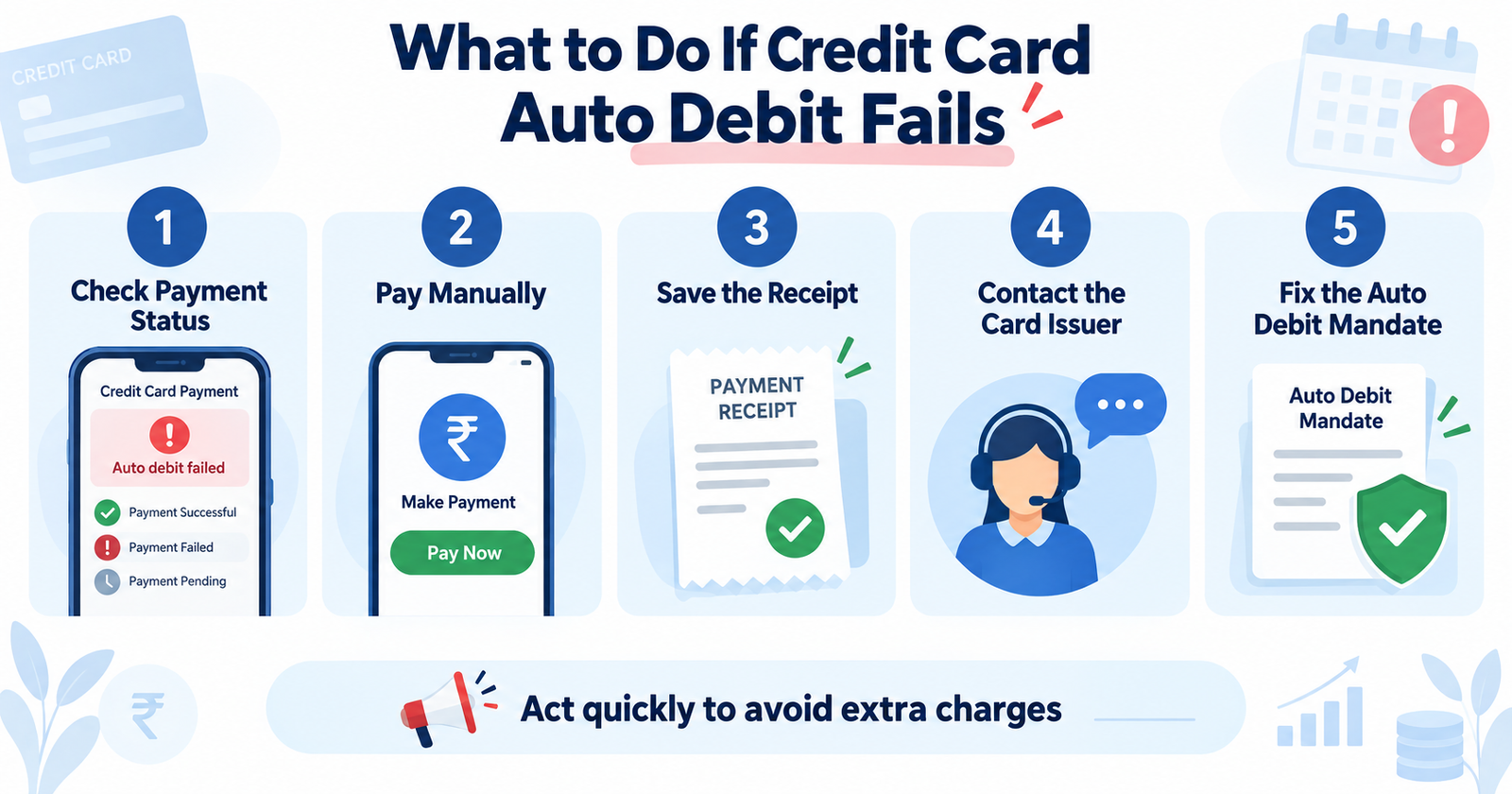
What to Do Immediately After Auto Debit Fails
1. Check Your Card Account
Open the official card app or internet banking portal. Confirm whether the bill is still unpaid.
Do not depend only on a message from an unknown number. Never click a suspicious payment link.
2. Pay Manually
Use a payment mode authorised by your card issuer. Pay the total amount due if possible.
If you cannot pay the full amount, at least understand the cost before paying only the minimum amount. The remaining balance may attract high finance charges.
3. Save the Receipt
Keep the transaction ID, screenshot and confirmation message. These can help if the payment is not reflected correctly.
4. Contact the Card Issuer
Ask why the auto debit failed. Also confirm whether any return charge, late fee or interest has been added.
5. Request a Fee Reversal
You can request a reversal if:
- It was your first payment failure.
- You paid immediately.
- You have a strong repayment record.
- The failure resulted from a documented technical issue.
- Sufficient funds were available at the time of debit.
A waiver is not guaranteed. Keep the request polite and provide evidence.
6. Fix the Mandate
Do not assume the next bill will be paid correctly. Re-register or update the mandate if required.
How to Request Reversal of Auto Debit Failure Charges
Contact customer care through an official channel. You can use the following message:
My credit card auto debit failed on the due date. I paid the outstanding amount manually as soon as I received the alert. My previous repayment record is regular. Please review the failure and consider reversing the autopay return or late-payment charge as a one-time goodwill waiver.
Attach proof if the failure was technical or your bank account had sufficient funds.
If the bank rejects your request, ask for the reason in writing. Escalate it through the issuer’s grievance process when the charge appears incorrect.
If you do not receive a satisfactory response within 30 days, you may be eligible to approach the RBI Ombudsman under the applicable complaint process.
How to Prevent Credit Card Auto Debit Failure
Maintain a Buffer Balance
Keep more than the bill amount in the linked bank account. This protects you from small deductions that happen before the auto debit.
Set Two Reminders
Set one reminder three days before the due date and another on the due date. Autopay should be a backup, not a reason to stop checking your bills.
Review the Monthly Statement
Check the total amount due, minimum amount due and payment date. Report an incorrect transaction before the due date.
Enable Alerts
Keep SMS, email and app alerts active. Update your mobile number and email address when they change.
Check the Linked Account
Review the bank account and mandate details after changing jobs, salary accounts or banks.
Pay Before the Due Date
You do not need to wait for autopay. If the funds are available, you can pay manually a few days early through an authorised channel.
Choose a Suitable Billing Cycle
Try to place the due date after your regular salary or income date. RBI rules allow cardholders to request a billing-cycle change, subject to the issuer’s process.
Good repayment habits also help when you apply for other credit products. Before accepting any loan, review the costs explained in our loan sanction letter checklist.
Auto Debit or Manual Payment: Which Is Better?
| Factor | Auto Debit | Manual Payment |
|---|---|---|
| Convenience | High | Requires action every month |
| Risk of forgetting | Lower | Higher without reminders |
| Risk of mandate failure | Possible | Not applicable |
| Control over timing | Limited | Higher |
| Need to monitor | Yes | Yes |
The best approach is to use both systems together. Keep autopay active, but check your statement and payment confirmation every month.
Simple Example
Suppose your total credit card bill is ₹30,000. The auto debit fails because the linked account has only ₹27,000.
You see the alert the same day and pay ₹30,000 manually through an authorised mode. You then contact the issuer and check whether an autopay return charge was added.
This quick action may help you avoid the account remaining past due for more than three days. It also reduces the risk of a late-payment fee and adverse credit reporting.
Now imagine you ignore the alert. The balance remains unpaid. Depending on the issuer’s terms, you may face a return charge, late fee, finance charges and GST. A continued delay may also affect your credit history.
That is why fast action matters more than the reason for failure.
Mistakes to Avoid
- Assuming autopay always works
- Keeping exactly the bill amount in the linked account
- Paying only the minimum without understanding interest
- Waiting for the issuer to retry the debit
- Using an unauthorised payment link
- Ignoring a failed-payment alert
- Forgetting to update an old mandate
- Paying twice without checking the card account
- Believing that one technical failure can never affect your credit record
If you are comparing borrowing costs for higher studies, our guide to the cheapest education loan interest rates in India also explains why fees and repayment terms matter alongside the advertised rate.
Frequently Asked Questions
What happens if credit card auto debit fails due to insufficient balance?
The issuer may add an autopay return charge under its terms. Your card bill also remains unpaid until you complete a successful payment. Pay manually as soon as possible.
Will I be charged a late fee on the due date itself?
Under RBI directions, late-payment and related charges can be levied only when the account remains past due for more than three days. A separate autopay return charge may still apply according to the issuer’s terms.
Does a failed credit card autopay immediately affect CIBIL?
No. A failed debit is not the same as an immediate credit-score drop. The risk arises when the payment remains overdue and the issuer reports it to a credit information company.
Can the bank reverse an auto debit failure charge?
You can request a reversal. The issuer may consider a one-time goodwill waiver, especially when you paid quickly or the failure was technical. Approval is not guaranteed.
Will the bank try the auto debit again?
Some issuers may retry it, while others may not. Do not wait for another attempt. Check the account and pay manually through an authorised method.
Should I select the minimum amount due for autopay?
It may prevent the required minimum from being missed, but the remaining balance usually attracts finance charges. Selecting the total amount due is generally better when you can maintain enough funds.
Can I pay the bill manually when auto debit is active?
Yes, but check the issuer’s process and timing. Paying too close to the scheduled debit can sometimes result in both payments being processed before the system updates.
Where can I find my exact autopay return charge?
Check your card issuer’s latest MITC, schedule of charges, monthly statement or official website. The amount can differ by card and may change.
Final Thoughts
Credit card auto debit is useful, but it is not completely risk-free.
Maintain enough balance. Read every payment alert. Check whether the amount was actually credited to your card account.
If auto debit fails, pay manually without delay. Then ask the issuer to explain any charge and request a reversal when you have a valid reason.
The safest habit is simple: use autopay for convenience, but verify every credit card payment yourself.

Hi, I’m Aditya Verma, a tech writer and digital content creator with a passion for exploring technology, apps, online tools, finance, education, and trending topics. I create well-researched and practical content that helps everyday readers understand useful information in a simple and easy-to-follow way.