
Loan Sanction Letter: 12 Important Things to Check Before Signing
Getting a loan sanction letter can feel like the final approval you were waiting for. But this is not the time to sign quickly.
The lender may have approved a lower amount than you requested. The interest rate may differ from the advertised rate. There may also be processing fees, insurance costs or conditions that were not clearly explained earlier.
A sanction letter gives you a chance to review the offer before moving ahead. Reading it carefully can save you from an expensive loan or an unaffordable EMI.
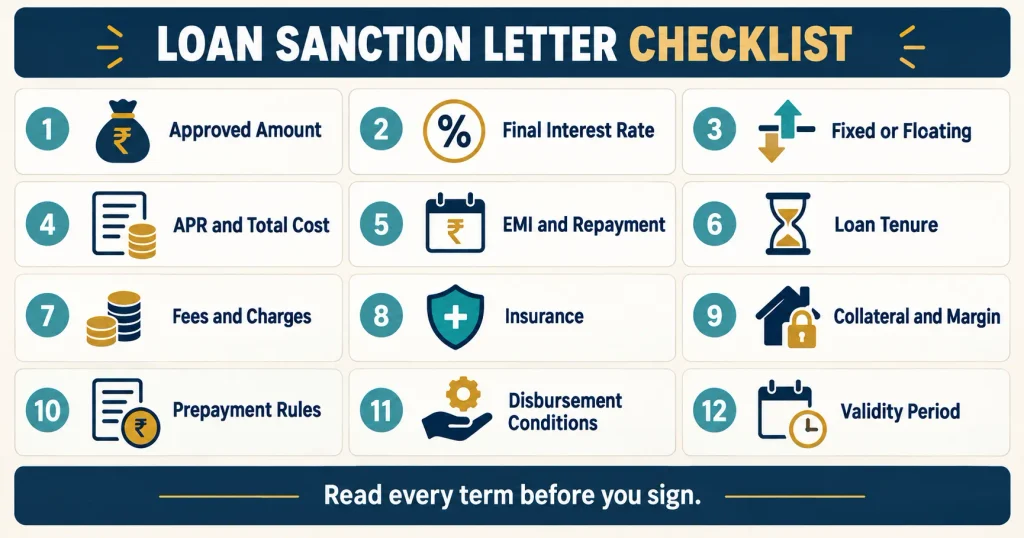
Here are 12 important things every borrower should check before accepting a loan sanction letter.
Table of Contents
What Is a Loan Sanction Letter?
A loan sanction letter is an official document issued by a bank or Non-Banking Financial Company, commonly called an NBFC.
It contains the terms under which the lender is willing to provide a loan.
The letter is normally issued after the lender checks your application, income, credit history and documents. For a secured loan, the lender may also examine the proposed collateral.
A sanction letter may include:
- Approved loan amount
- Interest rate
- Loan tenure
- Estimated EMI
- Fees and charges
- Collateral requirements
- Special conditions
- Validity period
- Disbursement requirements
Receiving this letter does not always mean that the money is ready for transfer. You may still need to complete final documentation and verification.
1. Check the Sanctioned Loan Amount
Start with the amount approved by the lender.
It may not be the same as the amount mentioned in your application.
For example, you may apply for ₹20 lakh, but the bank may sanction only ₹16 lakh. This can happen if your income, existing EMIs or property value does not support the requested amount.
Calculate how you will arrange the difference before accepting the offer.
Do not borrow more than you actually need simply because the lender has approved a higher amount. A larger loan also means a larger repayment burden.
2. Confirm the Final Interest Rate
Banks often advertise loans using phrases such as “interest rates starting from 8%.”
The lowest advertised rate is not guaranteed to every applicant. Your final rate can depend on your credit score, income, employer, loan amount and repayment history.
Check the exact rate printed in your sanction letter.
Also check whether any concession was promised to you. Some lenders offer concessions to women, pensioners or students of selected institutions.
If the written rate differs from the rate promised by a representative, ask the lender for clarification before signing.
3. Find Out Whether the Rate Is Fixed or Floating
A fixed interest rate generally remains unchanged for the period stated in the loan terms.
A floating rate can change when its linked benchmark changes.
For a floating-rate loan, check:
- Name of the benchmark
- Present benchmark rate
- Spread charged by the lender
- Frequency of rate resets
- Effect of a rate change on EMI
- Effect of a rate change on tenure
Do not accept the words “floating rate” without understanding how the rate is calculated.
A change in the benchmark may increase your EMI or extend your repayment period.
4. Compare the Interest Rate With the APR
The interest rate does not always show the complete cost of a loan.
The Annual Percentage Rate, or APR, provides a broader estimate. It considers the interest rate and applicable charges included in its calculation.
Ask the lender for a Key Facts Statement. The KFS should make it easier to understand the APR, repayment schedule and important charges.
When comparing two loans, look at both the interest rate and APR. A loan with a low advertised rate may cost more after fees are included.
5. Check the EMI and Total Repayment
A small EMI can make a loan look affordable. However, it may be the result of a very long tenure.
Check three figures:
- Monthly EMI
- Total interest payable
- Total amount repayable
Suppose you borrow ₹10 lakh. One lender offers a lower EMI over ten years. Another offers a slightly higher EMI over seven years.
The ten-year option may feel easier each month. But it can result in a higher total interest payment.
Choose an EMI that fits your budget without unnecessarily extending the loan.
6. Review the Loan Tenure
The tenure tells you how long you will repay the loan.
A long tenure reduces the monthly EMI. It also keeps you in debt for a longer period.
Check whether the tenure mentioned in the sanction letter matches the period you requested.
You should also consider your age and future income. A long loan continuing after retirement may become difficult to manage.
Pensioners should review age limits and repayment conditions carefully. Our guide to the SBI Pension Loan in India explains how tenure and pension income can affect eligibility.
7. Identify Every Fee and Charge
Do not check only the processing fee.
A loan may include several additional costs. These can increase the amount you pay before or after disbursement.
Look for:
- Loan processing fee
- Application charge
- Documentation charge
- Legal verification fee
- Property valuation fee
- Stamp duty
- Insurance premium
- Account administration charge
- Penal charge for missed payments
- Rate conversion charge
- Prepayment or foreclosure conditions
Ask whether the fees include GST.
You should also ask which charges are refundable if you decide not to proceed.
Never make a payment to a personal UPI ID or an unknown bank account. Use only the lender’s authorised payment method and obtain a receipt.
8. Check Whether Insurance Has Been Added
Loan protection insurance may help repay the outstanding loan after a covered event. However, it also comes at a cost.
Check whether the policy is optional or required under the product terms.
If insurance has been added, ask for:
- Name of the insurer
- Total premium
- Policy duration
- Coverage amount
- Major exclusions
- Cancellation terms
- Refund conditions
The lender may add the premium to your loan amount. If this happens, you may also pay interest on the premium.
Do not give consent until you understand the policy.
9. Understand the Collateral and Margin Requirement
A secured loan requires an asset as security.
For a home loan, the property is usually mortgaged to the lender. Other loans may be secured by gold, a fixed deposit or another acceptable asset.
Check the exact collateral mentioned in the letter. Also confirm which original documents must be submitted.
The lender may not finance the full cost of the asset or course.
For example, if a property costs ₹50 lakh and the bank sanctions ₹40 lakh, you must arrange the balance. Registration charges and taxes may also have to be paid separately.
Students should check the margin, collateral and moratorium conditions before accepting an education loan. You can compare current options in our guide to the cheapest education loan interest rates in India.
10. Read the Prepayment and Foreclosure Conditions
Your financial position may improve in the future. You may want to pay part of the loan early or close it completely.
Check whether the lender permits:
- Part-payment
- Full foreclosure
- Online prepayment
- Reduction of EMI
- Reduction of tenure
Ask whether a minimum amount or waiting period applies.
Rules can differ according to the lender, loan type and interest-rate structure. Do not assume that every loan can be closed early without conditions.
If prepayment is allowed, reducing the tenure can often save more interest than reducing the EMI.
11. Check All Conditions Before Disbursement
A loan sanction letter is not the same as loan disbursement.
Sanction means the lender has approved the loan under certain conditions. Disbursement means the money has actually been released.
Before disbursement, the lender may require:
- Signed loan agreement
- Updated income documents
- Original property papers
- Legal verification
- Property valuation
- Proof of margin payment
- Guarantor or co-applicant
- NACH or e-mandate registration
- Insurance documents
- College admission confirmation
Read this section carefully. Missing even one document can delay the release of funds.
Do not make a non-refundable payment to a property seller or college only because you received a sanction letter. First confirm the remaining requirements and expected disbursement date.
12. Check the Validity Period
A sanction letter is generally valid for a limited period. The exact validity should be mentioned in the document.
You may need to accept the offer and complete the required formalities within this period.
If the letter expires, contact the lender. The lender may:
- Extend the existing offer
- Request updated documents
- Issue a revised sanction letter
- Reassess the interest rate
- Ask for a fresh application
An expired letter does not always mean that the entire application must be restarted. The process depends on the lender and type of loan.
Loan Sanction Letter vs Loan Agreement
A sanction letter and loan agreement are not the same document.
| Loan Sanction Letter | Loan Agreement |
|---|---|
| Shows the loan offer approved by the lender | Contains the detailed legal terms of the loan |
| Issued before final disbursement | Usually signed before the funds are released |
| Includes major terms and conditions | Explains the rights and duties of both parties |
| May remain subject to final checks | Becomes the main contract governing the loan |
| Has a stated validity period | Remains applicable during the loan period |
Do not treat the sanction letter as a substitute for the loan agreement.
Compare both documents. The amount, rate, tenure and fees should be consistent.
How to Verify a Loan Sanction Letter
Fake loan sanction letters are sometimes used to collect money or personal information.
Use the following checks:
- Confirm that the lender is a genuine bank or registered NBFC.
- Check whether the letter came from an official email address.
- Match your name and application number.
- Verify the offer through the lender’s official app or website.
- Contact customer care using the number on the official website.
- Ask the branch to confirm the sanction reference number.
- Do not share your OTP, PIN or banking password.
- Do not pay an unknown agent for guaranteed approval.
A genuine lender may collect disclosed processing or verification charges. The warning sign is an unexplained payment requested through a personal account or unofficial channel.
What If the Details Are Incorrect?
Do not sign a sanction letter containing incorrect information.
Contact the lender and ask for a revised letter.
Request correction if you find an error in:
- Your name or contact details
- Sanctioned amount
- Interest rate
- Loan tenure
- Processing fee
- Property details
- Co-applicant information
- Repayment conditions
Keep the lender’s response in writing. A verbal promise made by an agent may be difficult to prove later.
Can You Reject a Loan After Sanction?
You can generally decide not to continue before signing the final agreement and receiving the money.
However, fees already paid may not always be refundable. The lender may have completed services such as legal verification or property valuation.
Check the refund conditions before making any payment.
If the loan has already been disbursed, cancellation becomes more complicated. Interest, processing costs or foreclosure conditions may apply.
How Long Does Disbursement Take After Sanction?
There is no fixed disbursement period for every type of loan.
A personal loan may be released quickly after digital verification. A home loan can take longer due to legal and property checks.
An education loan may be released according to the college fee schedule. The lender may pay the institution directly.
Ask the lender for a written list of pending steps. You should also request an estimated disbursement date for your application.
Quick Checklist Before Signing
Before accepting the loan sanction letter, confirm:
- The approved amount is correct.
- The final interest rate is clearly stated.
- You understand whether the rate is fixed or floating.
- The EMI fits your monthly budget.
- You have checked the APR.
- The tenure is suitable.
- All fees are disclosed.
- Insurance has not been added without clear consent.
- You understand the collateral and margin requirements.
- Prepayment conditions are acceptable.
- Disbursement conditions can be completed.
- The validity period gives you enough time.
Your emergency savings should not be exhausted simply to arrange a down payment. Use our Emergency Fund Calculator for Indian Families to estimate a suitable financial buffer.
Frequently Asked Questions
Final Words
A loan sanction letter should never be accepted without a careful review.
Check the amount, interest rate, APR, EMI and total repayment. Look for extra charges, insurance, collateral and prepayment conditions. Also confirm what must be completed before disbursement.
If a detail is incorrect, ask for a revised letter. If a condition is unclear, request a written explanation.
A few minutes spent checking the offer can protect you from unexpected charges and years of difficult repayments.
Disclaimer: This article is provided for general educational purposes only. Loan rates, fees and approval conditions vary between lenders and may change. Verify the latest terms directly with the bank or NBFC before applying or signing. Unifitein.com does not provide loans or guarantee approval.

Hi, I’m Aditya Verma, a tech writer and digital content creator with a passion for exploring technology, apps, online tools, finance, education, and trending topics. I create well-researched and practical content that helps everyday readers understand useful information in a simple and easy-to-follow way.