How to Negotiate a Personal Loan Interest Rate and Save on EMI
A personal loan can provide quick financial support. However, its interest rate can make repayment expensive.
Many borrowers accept the first offer they receive. They may not realise that the quoted rate is not always the lender’s best possible offer.
You can often negotiate a personal loan interest rate if you have a good credit profile, stable income or a strong relationship with the lender. Even a reduction of 1% or 2% can lower your EMI and save thousands of rupees.
This guide explains how to negotiate confidently. It also covers the right time to ask, what evidence to show and which loan charges you should compare.
Disclaimer: This article is for general educational purposes only. Loan rates, eligibility and charges depend on the lender and the borrower’s profile. Read the loan agreement before making a financial decision.
Table of Contents
Can You Negotiate a Personal Loan Interest Rate?
Yes, you can ask a bank or NBFC for a better rate. However, the lender is not required to accept your request.
Personal loans are usually unsecured. You do not provide a house, car or other asset as security. The lender therefore decides your rate by estimating the risk of lending to you.
It may consider:
- Your credit score and repayment history
- Monthly income
- Employer and job stability
- Existing EMIs
- Requested loan amount
- Chosen repayment period
- Banking relationship
- Recent credit applications
A borrower with reliable income and timely repayments presents less risk. That gives the borrower more room to negotiate.
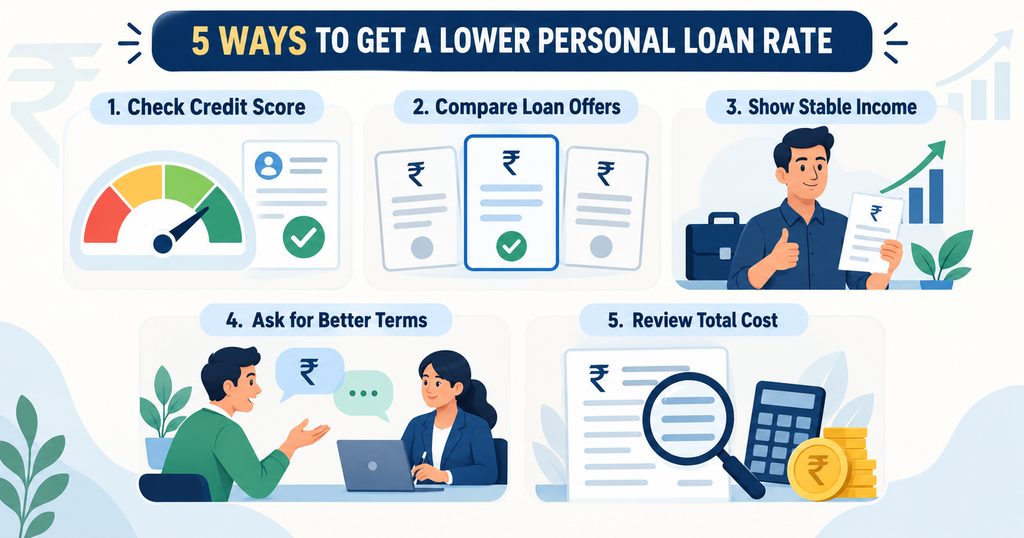
1. Check Your Credit Score Before You Apply
Your credit score is one of your strongest negotiation tools.
A high score suggests that you have handled credit responsibly. It may help you qualify for a lower personal loan interest rate. A CIBIL score above 750 is generally considered helpful, although every lender follows its own policy.
Check your credit report before applying. Look for incorrect late payments, unknown accounts or outdated balances. Raise a dispute if you find an error.
If your score needs improvement:
- Pay every EMI and credit card bill on time.
- Reduce high credit card balances.
- Avoid using most of your available credit limit.
- Do not submit several loan applications together.
- Clear overdue amounts.
Do not wait until the loan is approved to check your score. Know your position before the discussion begins.
Also, check Cheapest Education Loan Interest Rates in India 2026: Compare Top Banks
2. Compare Offers from Several Lenders
Negotiation becomes easier when you have another written offer.
Compare rates from at least three banks or NBFCs. Start with lenders that allow you to check eligibility without immediately making several formal applications.
Review the complete cost, not just the advertised rate. Compare:
- Annual interest rate
- Annual Percentage Rate, or APR
- Processing fee
- GST on applicable charges
- Prepayment or foreclosure rules
- Late payment charges
- Loan tenure
- Final EMI
The lowest interest rate does not always mean the cheapest loan. A lender may offer a lower rate but charge a large processing fee.
Once you have a better offer, show it to your preferred bank. Ask whether it can match or beat the rate.
3. Use Your Salary and Employment Stability
Regular income reduces the lender’s risk.
Mention it clearly if you:
- Work for the government or a well-established company
- Have remained with the same employer for several years
- Receive a regular salary in your bank account
- Recently received a salary increase
- Have an additional documented source of income
Keep recent salary slips, bank statements and employment proof ready. Self-employed applicants can use income tax returns, bank statements and business records.
Do not exaggerate your income. The lender will verify your documents.
4. Ask Your Existing Bank for a Relationship Rate
Your existing bank already knows your transaction and repayment history.
You may have more negotiating power if you maintain:
- A salary account
- A long-standing savings account
- A fixed deposit
- A credit card with timely payments
- A previous loan repaid without delay
Ask whether you qualify for a pre-approved offer, loyalty discount or relationship pricing. Also check the final cost. A pre-approved loan is convenient, but it is not automatically the cheapest option.
5. Reduce Your Debt-to-Income Ratio
Your debt-to-income ratio shows how much of your monthly income already goes toward debt.
For example, if you earn ₹60,000 and pay ₹24,000 in existing EMIs, 40% of your income is already committed.
A high ratio can make a new loan appear risky. The lender may offer a higher rate, a smaller amount or reject the application.
Before applying, consider paying off a small loan or reducing your credit card balance. This can improve your repayment capacity and help you get a lower rate on a personal loan.
6. Request Only the Amount You Need
Do not borrow extra money simply because you are eligible for it.
A smaller loan can reduce your EMI and total interest. It may also make your application more comfortable for the lender.
Prepare a clear expense estimate. Apply for the amount you genuinely need and can repay without disturbing essential monthly expenses.
Also, check Loan Sanction Letter: 12 Important Things to Check Before Signing
7. Choose the Loan Tenure Carefully
A longer tenure lowers the monthly EMI. However, it normally increases the total interest paid.
A shorter tenure may save interest, but it creates a larger EMI. Choose a period that keeps the payment affordable without unnecessarily stretching the loan.
Do not ask for a very short tenure only to secure a better offer. Missing payments will cost far more than the expected saving.
8. Negotiate the Processing Fee and Other Charges
The lender may refuse to change the rate. That does not mean the discussion is over.
Ask whether it can:
- Reduce or waive the processing fee
- Remove optional bundled products
- Offer a cashback benefit
- Reduce documentation charges
- Provide better prepayment terms
- Waive a non-essential service charge
Never accept insurance or another product without understanding whether it is optional. Ask for a written breakdown of every charge.
9. Apply When Your Financial Profile Is Strong
Timing matters.
You may have a stronger case after:
- A salary increase
- Repaying an existing loan
- Correcting an error in your credit report
- Reducing your card balances
- Completing a longer period with your employer
Avoid applying immediately after missing a payment or submitting several credit applications. Waiting until your profile improves may produce a better offer.
10. Use a Co-Applicant Only When It Truly Helps
Some lenders may consider a co-applicant. A co-applicant with stable income and a strong credit profile may improve the application.
However, both people become responsible for the debt. A missed EMI can affect both credit records.
Do not add someone only to obtain a small rate reduction. Discuss repayment responsibility before signing anything.
What to Say to the Lender
You do not need complicated financial language. Keep the request direct and polite.
You can say:
I have a strong repayment record and stable monthly income. Another lender has offered me a lower rate for the same loan amount and tenure. I would prefer to continue with your bank. Can you offer a better interest rate or reduce the processing fee?
If you do not have a competing offer, try:
My salary account and transaction history are with your bank. Could you please check whether I qualify for a relationship rate or a lower processing fee?
Ask the lender to share the revised offer in writing. A verbal promise is not enough.
How Much Can a Lower Rate Save?
Consider a ₹5 lakh personal loan for five years.
| Details | Offer A | Offer B |
|---|---|---|
| Loan amount | ₹5,00,000 | ₹5,00,000 |
| Interest rate | 13% | 11% |
| Approximate EMI | ₹11,377 | ₹10,871 |
| Approximate total interest | ₹1,82,592 | ₹1,52,273 |
Reducing the rate from 13% to 11% lowers the EMI by about ₹506 per month. It saves approximately ₹30,319 in total interest over five years.
These figures are illustrative. Your final EMI can vary because of the lender’s calculation method, repayment schedule, charges and rounding.
Should You Use a Personal Loan Balance Transfer?
If you already have a loan, the current lender may not revise its rate. You can then explore a personal loan balance transfer.
This moves the unpaid loan balance to another lender offering better terms.
Before transferring, calculate:
- Interest remaining on the old loan
- Foreclosure or prepayment charges
- New processing fee
- New interest rate
- Remaining tenure
- Total saving after every charge
A lower advertised rate is not enough. The transfer is useful only when the net saving is meaningful.
Be careful about extending the tenure. It may reduce your EMI but increase the total amount paid.
Check the Key Facts Statement Before Signing
Ask for the Key Facts Statement and read it carefully.
Check:
- Sanctioned loan amount
- Interest rate
- Whether the rate is fixed or floating
- APR
- EMI and repayment schedule
- Processing fee
- Penal charges
- Prepayment conditions
- Amount actually credited to your account
Compare the APR because it provides a broader view of borrowing cost than the interest rate alone.
Also, check FASTag Annual Pass Renewal Problems: Causes and Easy Fixes
Common Personal Loan Negotiation Mistakes
Avoid these errors:
- Accepting the first offer without comparison
- Looking only at the EMI
- Ignoring the APR and processing fee
- Making too many formal applications
- Hiding existing loans
- Choosing an unaffordable short tenure
- Believing verbal promises
- Paying an agent before verifying the lender
- Sharing OTPs or banking passwords
- Taking a larger loan than required
The aim is not only to reduce personal loan EMI. It is to reduce the overall borrowing cost while keeping repayment manageable.
Quick Checklist Before Accepting the Offer
- Check your latest credit report.
- Compare at least three suitable offers.
- Use the same loan amount and tenure for comparison.
- Ask for relationship benefits.
- Mention stable employment and documented income.
- Negotiate the interest rate and processing fee.
- Calculate the total repayment.
- Read prepayment and foreclosure terms.
- Review the Key Facts Statement.
- Obtain the final offer in writing.
Frequently Asked Questions
Final Thoughts
The best way to negotiate a personal loan interest rate is to prepare before applying.
Check your credit profile. Compare offers with the same loan amount and tenure. Show proof of stable income. Then ask your preferred lender to improve the rate or reduce the fees.
Do not focus only on the EMI. Review the APR, processing charges, prepayment rules and total repayment.
Even a small rate reduction can produce a meaningful saving. A calm discussion supported by good documents gives you the strongest chance of securing better loan terms.

Hi, I’m Aditya Verma, a tech writer and digital content creator with a passion for exploring technology, apps, online tools, finance, education, and trending topics. I create well-researched and practical content that helps everyday readers understand useful information in a simple and easy-to-follow way.