DJI Osmo Pocket 4 vs iPhone: Which Is Better for Content Creators?
The iPhone has become the default camera for many content creators. It is always nearby. It records high-quality video. You can also edit and publish without moving files to another device.
The DJI Osmo Pocket 4 takes a different approach. It is a small dedicated camera with a one-inch sensor, a mechanical gimbal and intelligent subject tracking. It is designed mainly for filming.
So, which one should a creator choose?
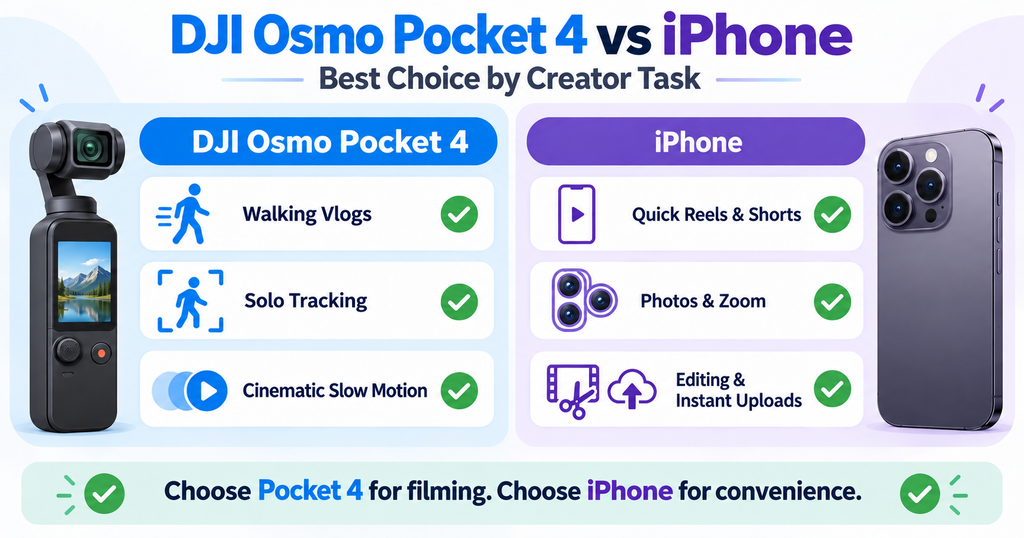
The short answer is simple. The DJI Osmo Pocket 4 is better for smooth vlogs, solo tracking and cinematic movement. A recent iPhone is better for convenience, multiple camera angles, fast editing and instant posting.
However, the right choice depends on what you create. This detailed DJI Osmo Pocket 4 vs iPhone comparison will help you decide.
Note: iPhone camera features vary by model. This comparison focuses mainly on recent Pro models, including the iPhone 17 Pro and Pro Max. Always compare the exact specifications of the iPhone you plan to buy.
Table of Contents
DJI Osmo Pocket 4 vs iPhone: Quick Comparison
| Feature | DJI Osmo Pocket 4 | Recent Pro iPhone |
|---|---|---|
| Main purpose | Dedicated video camera | Smartphone with advanced cameras |
| Stabilisation | Three-axis mechanical gimbal | Optical and electronic stabilisation |
| Main sensor | One-inch CMOS sensor | Multiple computational camera sensors |
| Maximum slow motion | Up to 4K at 240fps | Depends on the iPhone model |
| Subject tracking | Physical gimbal tracking | Software-based tracking and framing |
| Camera choices | One main field of view with crop or zoom options | Main, ultra-wide and telephoto options |
| Vertical video | Supported | Supported |
| Built-in storage | 107GB plus microSD support | Depends on selected iPhone storage |
| Editing and posting | Usually requires phone or computer | Available directly on the device |
| Calls and apps | No | Yes |
| Best for | Vlogging, walking shots and solo filming | Everyday content, quick Reels and mobile workflow |
This table gives a quick answer. The real differences become clearer when we compare how both devices perform in daily content creation.
What Makes the DJI Osmo Pocket 4 Different?
The Osmo Pocket 4 is not trying to replace every feature of a smartphone. It focuses on video.
Its main attraction is the built-in three-axis gimbal. The camera physically moves to keep footage stable. It can also turn and follow a subject while recording.
DJI has paired this gimbal with a one-inch CMOS sensor. The camera supports high-resolution video, slow motion and a flat D-Log colour profile for advanced editing.
Important DJI Osmo Pocket 4 features include:
- One-inch CMOS sensor
- Three-axis mechanical gimbal
- Up to 4K/240fps video
- D-Log recording
- Subject tracking
- Gesture control
- Two-inch touchscreen
- 107GB of built-in storage
- microSD card support
- External microphone support
- Manual exposure controls
- Vertical recording
The camera is compact enough for travel. It is also much less complicated than carrying a mirrorless camera with a separate gimbal.
Why Content Creators Still Choose the iPhone
An iPhone is more than a camera. It is a complete creation and publishing device.
You can record a Reel, edit it, add captions, create a thumbnail and upload it from the same screen. You can also answer messages, check analytics and manage brand work.
Recent Pro iPhones offer several useful camera options. You can switch between wide, ultra-wide and telephoto views. This gives the iPhone more framing flexibility than a single-lens pocket camera.
The iPhone also benefits from computational photography. It automatically manages exposure, colour, HDR and noise reduction. This helps beginners get attractive results without changing many settings.
If you follow smartphone developments closely, you may also like our coverage of Apple’s growing iPhone production plans in India.
Video Quality: Which One Looks Better?
Both devices can create excellent video. They simply produce it in different ways.
The DJI Osmo Pocket 4 has a large one-inch sensor for such a small camera. This can help it capture better natural detail, depth and low-light footage. Its D-Log profile also gives experienced editors more freedom during colour grading.
The iPhone relies heavily on image processing. It combines information from its camera system and software to create a polished result immediately.
For quick social media content, the iPhone often looks ready to publish without much work. For a carefully edited travel film or YouTube vlog, the Pocket 4 can provide a more camera-like result.
Winner for ready-to-post video: iPhone
Winner for controlled and graded footage: DJI Osmo Pocket 4
Stabilisation: The Pocket 4 Has the Advantage
Stabilisation is one of the biggest differences in this comparison.
The iPhone uses optical and electronic stabilisation. Its Action mode can make moving footage look impressively steady. However, strong electronic stabilisation may crop the frame and rely on software processing.
The Osmo Pocket 4 uses a physical three-axis gimbal. The camera head moves to reduce shake and keep the horizon stable.
This is especially helpful for:
- Walking vlogs
- Travel videos
- Property tours
- Product B-roll
- Food videos
- Event coverage
- Running or moving shots
- Cinematic reveals
The difference is easy to notice when you walk and talk to the camera. The Pocket 4 usually creates smoother motion without requiring a separate phone gimbal.
Winner: DJI Osmo Pocket 4
Solo Filming and Subject Tracking
The Osmo Pocket 4 is a strong option for people who create alone.
You can place it on a small tripod and allow the camera to follow you. The gimbal can physically rotate as you move across the frame. Gesture controls can also make it easier to start or manage a shot from a distance.
This is useful for:
- Solo travel creators
- Fitness instructors
- Teachers
- Product presenters
- Cooking creators
- Beauty creators
- Small business owners
An iPhone can track faces in supported apps and automatically adjust focus or framing. However, the phone itself does not physically rotate unless you place it on a separate tracking mount or gimbal.
Winner: DJI Osmo Pocket 4
Camera Flexibility and Zoom
The iPhone has a clear advantage when you need different focal lengths.
A Pro iPhone can offer main, ultra-wide and telephoto cameras. You can quickly capture a room, a normal talking shot or a distant subject without changing devices.
The Pocket 4 focuses mainly on one camera and one natural field of view. Digital zoom or crop modes can help, but they do not provide the same flexibility as separate lenses.
This matters when recording:
- Concerts
- Wildlife
- Architecture
- Large indoor spaces
- Distant subjects
- Product close-ups
The iPhone is also faster when an unexpected moment occurs. You can point it in a new direction immediately. A gimbal camera may need a moment to rotate and settle.
If camera hardware is important to you, you can also see how a competing flagship may develop in our OnePlus 16 camera and specification guide.
Winner: iPhone
Low-Light Performance
The Pocket 4’s one-inch sensor gives it a strong foundation for low-light video. A larger sensor can collect more light and produce a more natural result in difficult conditions.
The iPhone uses powerful processing to brighten dark scenes. This can look impressive on a phone screen. However, aggressive processing may sometimes create a sharper or less natural appearance.
The better result depends on the situation.
For a creator who understands exposure and colour grading, the Pocket 4 provides greater control. For someone who wants to press record and receive a bright, usable clip, the iPhone is easier.
Winner for manual control: DJI Osmo Pocket 4
Winner for simple automatic shooting: iPhone
Vlogging Experience
The DJI Osmo Pocket 4 feels designed for vlogging.
It is small, light and easy to hold. The rotating screen helps you frame yourself. The gimbal makes walking footage smooth. Subject tracking is useful when you put the camera down.
It also keeps your filming separate from your phone. Calls and notifications will not interrupt the camera. Your phone remains available for maps, scripts or communication.
The iPhone is still an excellent vlogging tool. Its larger display makes framing and reviewing clips easier. You can also connect many microphones, lights, grips and editing apps.
The main issue is distraction. The same device is also handling messages, calls and social media.
Winner for dedicated vlogging: DJI Osmo Pocket 4
Winner for casual vlogging: iPhone
Reels, Shorts and Vertical Video
Both devices can record vertical content.
The iPhone offers the easiest workflow. Record the clip, open Instagram or YouTube, make changes and publish it. There is no transfer step.
The Pocket 4 can record vertically while keeping its stabilisation and tracking benefits. This makes it useful for polished Reels and Shorts. However, you may need to move the footage to your phone before editing or uploading.
Creators who want more reach should remember that camera quality is only one part of growth. Topic choice, viewer retention and consistency matter too. Our guide on how to get more views without paid promotion covers those areas in more detail.
Winner for speed: iPhone
Winner for smooth vertical movement: DJI Osmo Pocket 4
Slow-Motion Recording
The Osmo Pocket 4 can record up to 4K at 240fps. This is a major advantage for creators who regularly make slow-motion content.
It can be useful for:
- Sports
- Dance videos
- Water splashes
- Product shots
- Fashion transitions
- Food preparation
- Travel B-roll
High-frame-rate modes can have limitations. They may crop the image or reduce access to certain colour profiles. They also create large files.
iPhone slow motion is easier to capture and share. Its exact resolution and frame-rate options depend on the model. For advanced slow motion, the Pocket 4 offers the more specialised package.
Winner: DJI Osmo Pocket 4
Photos: The iPhone Is More Practical
The Pocket 4 can take photos and save RAW files. Its panorama modes can also use the gimbal to capture and combine several images.
However, it remains a video-first device.
The iPhone is more convenient for everyday photography. Its larger screen helps with composition. Multiple cameras provide more framing options. Portrait, night and computational photography features make it easier to get a finished image quickly.
The iPhone is also better for capturing, editing and sharing a photo within seconds.
Winner: iPhone
Audio and Microphone Support
Good audio is more important than many new creators realise.
The Osmo Pocket 4 includes built-in microphones and works with compatible wireless microphones. It can also accept supported third-party microphones through USB-C or a suitable adapter.
The direct DJI microphone workflow is useful for interviews and vlogging. A compact camera and wireless mic can form a simple creator kit.
The iPhone also supports many wired and wireless microphones. It has access to a wider range of recording apps. However, you may need an adapter or compatible receiver depending on the microphone and iPhone model.
Both can produce strong results. The Pocket 4 feels more focused. The iPhone offers more app flexibility.
Result: Tie
Editing and Publishing Workflow
The iPhone wins this section clearly.
You can use apps such as CapCut, VN, InShot, iMovie or professional editing tools directly on the phone. After editing, you can upload to Instagram, YouTube or another platform immediately.
The Pocket 4 normally adds an extra step. You must transfer the footage to a phone, tablet or computer. Large 4K and slow-motion files can take time and consume storage.
That extra step may be acceptable for long-form YouTube videos. It may feel unnecessary for someone posting several short videos each day.
Winner: iPhone
Storage and File Management
The Osmo Pocket 4 includes 107GB of internal storage. It also supports microSD cards.
That is useful for long shooting days. You can replace or expand a memory card instead of filling your phone.
An iPhone has fixed internal storage. You cannot add a microSD card. High-quality video can quickly consume space, especially when the phone already contains apps, photos and downloaded files.
The iPhone does make cloud backup and mobile file management convenient. However, extra internal storage can make the phone much more expensive.
Winner for expandable recording space: DJI Osmo Pocket 4
Winner for simple cloud workflow: iPhone
Battery Life and Long Shooting Days
Battery use depends on resolution, frame rate, screen brightness, temperature and wireless features.
The Pocket 4 has one job while recording. It does not need to manage calls, social apps and background phone tasks at the same time. Fast charging and optional battery accessories can help during travel.
An iPhone may last well, but long video sessions can drain the same battery you need for communication, navigation and uploads.
The Pocket 4 therefore has a practical advantage as a separate camera. Your phone battery remains available for other work.
Winner for a separate filming setup: DJI Osmo Pocket 4
Durability and Outdoor Use
The Pocket 4’s gimbal is one of its best features, but it also needs care. The moving camera head should be protected during travel. This is not the ideal device for careless handling or underwater filming.
Recent iPhones offer water and dust resistance under specified conditions. They are easier to use in light rain or unpredictable daily situations. A protective case adds another layer of security.
Neither device should be treated carelessly. Water resistance can also decrease with normal wear.
For extreme sports, swimming or rough outdoor use, an action camera may be more suitable than either option.
Winner: iPhone
Price and Overall Value in India
The correct value comparison is not simply camera against phone.
An iPhone also replaces many other devices. It handles calls, apps, editing, navigation, payments and publishing. If you already need a new premium phone, its camera may be enough.
The Osmo Pocket 4 is an additional device. You may also buy a memory card, protective case, tripod, microphone or battery accessory.
Still, the Pocket 4 can be more economical than buying a mirrorless camera, lens and gimbal. It gives solo creators a compact production setup without the weight of a larger system.
Prices and availability can change. Indian buyers should compare the official warranty, seller reputation and complete accessory cost before ordering.
DJI Osmo Pocket 4 Advantages
- Smoother footage from a physical gimbal
- Excellent for walking vlogs
- Strong subject tracking
- Helpful for solo creators
- One-inch sensor
- D-Log for colour grading
- Up to 4K/240fps slow motion
- 107GB internal storage
- microSD card support
- Keeps filming separate from your phone
- Compact compared with a camera and gimbal setup
DJI Osmo Pocket 4 Disadvantages
- Only one main camera viewpoint
- Less convenient for instant posting
- Small display
- Gimbal needs protection
- Not designed for rough water use
- Another device to charge and carry
- Extra accessories increase the total cost
- File transfer adds time to the workflow
iPhone Advantages
- Always available
- Multiple camera options on Pro models
- Easy automatic processing
- Fast photo and video capture
- Large display
- Edit and publish on the same device
- Wide range of creator apps
- Better for everyday photography
- More practical in unpredictable conditions
- No separate camera required
iPhone Disadvantages
- Less natural stabilisation than a physical gimbal
- No physical subject-following movement without an accessory
- Fixed storage
- Video consumes phone battery and space
- Notifications and calls can interrupt filming
- Premium models are expensive
- Heavy processing may not suit every creator
Who Should Buy the DJI Osmo Pocket 4?
Choose the DJI Osmo Pocket 4 if you:
- Create walking or travel vlogs
- Regularly film yourself alone
- Want smooth footage without carrying a separate gimbal
- Enjoy colour grading
- Need strong slow motion
- Want expandable storage
- Prefer a dedicated camera
- Already own a capable phone
It is especially useful for travel creators, YouTubers, fitness instructors and anyone who moves frequently while recording.
Who Should Continue Using an iPhone?
Choose an iPhone if you:
- Create quick Reels and Shorts
- Want to edit and publish immediately
- Need several focal lengths
- Take many photos as well as videos
- Prefer automatic camera settings
- Do not want to carry another device
- Are new to content creation
- Already own a recent Pro iPhone
For many beginners, the phone they already own is the smarter starting point. Better lighting, sound and storytelling may improve content more than buying another camera.
Should You Own Both?
For a serious creator, the best answer may be both.
Use the Pocket 4 as the main video camera. Use the iPhone for wide shots, telephoto clips, photos, behind-the-scenes content, editing and uploads.
This also gives you a backup camera. If one device runs out of power or storage, the other can continue recording.
Owning both is not essential. It becomes valuable when content creation is regular work rather than an occasional hobby.
Frequently Asked Questions
Is the DJI Osmo Pocket 4 better than an iPhone for vlogging?
It is generally better for walking vlogs, smooth movement and solo subject tracking. The iPhone is better when you want the fastest recording, editing and publishing workflow.
Can the DJI Osmo Pocket 4 replace an iPhone camera?
It can replace the iPhone for many video tasks. It cannot replace the phone’s multiple lenses, apps, communication features and instant sharing.
Is the DJI Osmo Pocket 4 good for Instagram Reels?
Yes. It supports vertical recording and offers smooth stabilisation. However, footage normally needs to be transferred to a phone before posting.
Which device is better for YouTube videos?
The Pocket 4 is better for creators who want smooth, controlled and carefully edited footage. The iPhone is better for simple production and fast uploads. Both can create professional-looking YouTube videos.
Does the DJI Osmo Pocket 4 need an iPhone?
No. It can record independently. A smartphone is still useful for the DJI app, file transfer, remote control, editing and publishing.
Which is better for low-light video?
The Pocket 4’s one-inch sensor gives it strong potential, especially with manual control. The iPhone makes low-light filming easier through automatic processing. Results depend on the scene and settings.
Is the Pocket 4 better than an iPhone for photos?
Not for most users. The iPhone offers multiple cameras, a larger screen and faster editing and sharing. The Pocket 4 is mainly designed for video.
Is DJI Osmo Pocket 4 worth buying if I already have a Pro iPhone?
It can be worthwhile if you need better walking stabilisation, physical tracking, long-form vlogging or a separate filming device. It may be unnecessary if you mainly make casual Reels and short handheld clips.
Final Verdict: DJI Osmo Pocket 4 or iPhone?
There is no universal winner.
The DJI Osmo Pocket 4 is the better filming tool. Its physical gimbal, one-inch sensor, subject tracking and slow-motion modes make it excellent for vloggers and solo creators.
The iPhone is the better all-in-one creator device. It offers several cameras, fast automatic results, powerful editing apps and immediate publishing.
Choose the Pocket 4 when movement and video quality are your priorities. Choose the iPhone when speed, flexibility and convenience matter more.
If you already have a recent iPhone, use it first. Improve your lighting, audio and storytelling. Buy the Pocket 4 only when its gimbal, tracking or dedicated-camera workflow solves a real problem in your content.

Hi, I’m Aditya Verma, a tech writer and digital content creator with a passion for exploring technology, apps, online tools, finance, education, and trending topics. I create well-researched and practical content that helps everyday readers understand useful information in a simple and easy-to-follow way.