
Apple Big News India: iPhone Production Could Reach 30–35% by 2031
Apple Big News India is gaining attention as the country prepares to take a much larger role in Apple’s global manufacturing network.
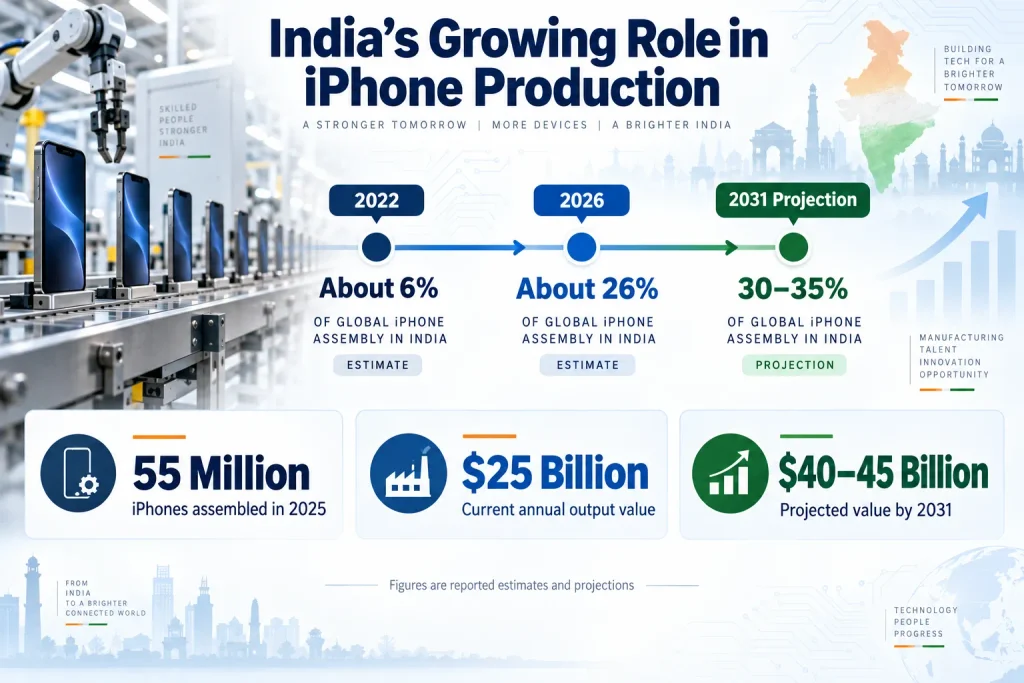
India currently produces approximately one-quarter of the world’s iPhones. That share could increase to between 30% and 35% over the next five years, according to a Ministry of Electronics and Information Technology official cited in recent reports.
If this projection becomes reality, around one out of every three iPhones could be assembled in India by 2031.
The annual value of iPhone production in the country could also rise from approximately $25 billion to between $40 billion and $45 billion.
This would strengthen India’s position as a global electronics manufacturing centre. It would also help Apple build a more diversified supply chain outside China.
The development comes during a new chapter in Apple’s history. John Ternus is now Apple’s CEO, while Tim Cook serves as executive chair of the company’s board.
Table of Contents
Apple Big News India: What Has Been Reported?
The main development is Apple’s expected manufacturing expansion in India.
A MeitY official reportedly said that India’s share of global iPhone production could rise from around 25% to between 30% and 35% within five years.
The value of annual iPhone manufacturing in India could consequently increase to approximately $40 billion or $45 billion by 2031.
These numbers are projections rather than guaranteed production targets. Market demand, trade policies, infrastructure and Apple’s investment decisions could affect the final outcome.
However, the direction is clear. India is becoming increasingly important to Apple’s manufacturing strategy.
The Free Press Journal reported that Apple assembled approximately 55 million iPhones in India during 2025. This was an increase of around 53% compared with 36 million units in 2024.
India’s Growing Share of iPhone Production
India’s progress in iPhone manufacturing has been rapid.
The country reportedly accounted for only around 6% of global iPhone production four years before 2026. Its estimated share is expected to reach approximately 26% during 2026.
Reaching between 30% and 35% by 2031 would represent another major step.
| Manufacturing indicator | Reported or projected figure |
|---|---|
| India’s iPhone share four years before 2026 | Around 6% |
| Estimated share in 2026 | Approximately 26% |
| Possible share by 2031 | Around 30–35% |
| iPhones assembled in India during 2025 | Approximately 55 million |
| Estimated 2025 production value | Around $25 billion |
| Possible production value by 2031 | Around $40–45 billion |
These figures show how India has moved from being a small assembly location to becoming one of Apple’s most important production bases.
John Ternus Begins a New Chapter at Apple
Apple’s manufacturing expansion is taking place during an important leadership transition.
Tim Cook served as Apple’s CEO from 2011 to 2026. He now serves as executive chair of Apple’s board.
John Ternus has succeeded Cook as CEO and also serves on the company’s board of directors. Apple’s official leadership page confirms the current positions held by Ternus and Cook.
Ternus joined Apple’s product design team in 2001. He became vice president of Hardware Engineering in 2013 and joined Apple’s executive team in 2021 as senior vice president of Hardware Engineering.
During his career at Apple, he worked on several generations of the iPhone, Mac, iPad, Apple Watch and AirPods.
His background in hardware engineering could be important as Apple expands its manufacturing network and introduces new production methods.
The change in leadership does not mean that Apple’s India plans will suddenly change. Supply-chain expansion involves years of planning, supplier development and capital investment.
India’s role is therefore expected to remain important during Apple’s new leadership era.
Why Is Apple Increasing Production in India?
Apple has several reasons for expanding iPhone manufacturing in India.
Reducing Dependence on One Country
China remains a central part of Apple’s production system. It has an established supplier network, experienced workers and large manufacturing facilities.
However, depending heavily on one country creates risks.
Trade disputes, tariffs, geopolitical tensions, public health emergencies and shipping disruptions can affect production. Apple can reduce these risks by developing additional manufacturing capacity in India.
This does not mean that Apple is completely leaving China.
China is likely to remain an essential manufacturing base for many years. India provides Apple with a second major production centre and makes its supply chain more resilient.
India’s Expanding Manufacturing Ecosystem
India now has several large iPhone assembly facilities.
Tata Electronics and Foxconn are among Apple’s most important manufacturing partners in the country. Reports suggest that Apple’s Indian operations include five major assembly facilities, with three operated by Tata Group and two by Foxconn.
A network of approximately 45 component suppliers reportedly supports these operations.
This growing ecosystem can make future expansion easier. Suppliers can provide parts closer to assembly plants. That can reduce transportation time and improve coordination.
Government Manufacturing Incentives
India’s Production Linked Incentive scheme played an important role in attracting large electronics manufacturers.
The mobile-phone PLI scheme was introduced in April 2020. It rewarded eligible manufacturers for increasing local production.
Apple’s suppliers became major beneficiaries of the programme.
The original mobile manufacturing incentive period has ended, but India is reportedly preparing further support for electronics production.
Any future incentives could encourage manufacturers to increase capacity, expand exports and source more components locally.
Proposed Tax Changes Could Support Apple’s Suppliers
India has also proposed extending certain tax exemptions until March 31, 2041.
This does not mean that Apple would receive a general exemption from all taxes.
The proposal relates to foreign companies that supply machinery to contract manufacturers in India. Apple and similar companies may own expensive equipment used by their manufacturing partners.
Without clear rules, owning that equipment could potentially create additional tax exposure.
The proposed exemption would provide more certainty to foreign companies supplying machinery to Indian manufacturers.
India has also proposed exemptions connected with storing and supplying components inside customs-bonded areas when those parts are used for exported electronics.
According to Reuters, the proposed changes could remain effective until 2041 if approved.
These measures could make it easier for Apple and its suppliers to manage equipment and components in India.
Foxconn and Tata Electronics Are Important Partners
Apple does not directly assemble most iPhones itself. It relies on manufacturing partners.
Foxconn has been one of Apple’s largest iPhone assemblers for many years. The company already operates significant manufacturing facilities in India.
Reports suggest that Foxconn has also examined the possibility of developing a new electronics facility in Gujarat. A possible location near Sanand in Ahmedabad district could cover more than 200 acres.
A final investment decision had not been confirmed at the time of reporting.
Tata Electronics is another important part of Apple’s India strategy.
Tata’s growing presence is notable because it gives an Indian company a major position within Apple’s international manufacturing network.
The involvement of both Foxconn and Tata could help expand production capacity while creating greater competition within Apple’s supplier base.
Will More iPhones Be Made Completely in India?
The phrase “Made in India” can sometimes create confusion.
Assembly is only one part of smartphone production. An iPhone contains displays, camera sensors, processors, memory, batteries and many other components.
Some of these parts may still be imported even when final assembly takes place in India.
India’s long-term challenge is therefore not limited to assembling more phones. The country also needs to increase the local production of components.
Greater component manufacturing would create more value within India. It could also reduce dependence on imported parts and improve supply-chain efficiency.
Building this ecosystem will take time. Advanced smartphone components require specialized technology, trained workers and large investments.
What Could This Mean for Indian Consumers?
Higher local production could offer several benefits for Indian buyers.
Improved Availability
More local manufacturing could make it easier for retailers to receive new iPhone models.
Better supply may reduce shortages during major launches and festival sales. However, Apple will continue exporting a large share of India-made devices to international markets.
Faster Product Distribution
Local assembly can reduce the distance between factories and Indian retailers.
This may help Apple distribute certain models more efficiently. It does not guarantee that every product will be available immediately.
More Jobs and Technical Skills
New manufacturing facilities can create jobs in assembly, engineering, quality control, logistics and facility management.
Supplier expansion can also create indirect employment.
The long-term benefit will depend on the quality of these jobs, worker safety, training and opportunities for career development.
Growth of the Supplier Ecosystem
Apple’s presence can encourage component suppliers to invest in India.
These suppliers may later serve other electronics companies as well. The result could be a broader and more competitive manufacturing ecosystem.
Will iPhones Become Cheaper in India?
More local production does not automatically mean significantly cheaper iPhones.
An iPhone’s retail price depends on many factors. These include imported components, currency exchange rates, taxes, logistics, marketing and Apple’s pricing strategy.
A large portion of India-made iPhones is also exported.
Local manufacturing may improve availability and reduce some costs. However, Apple can choose to retain those savings instead of reducing retail prices.
Indian consumers should therefore not assume that a higher manufacturing share will immediately lead to major price cuts.
Prices could become more competitive over time if more components are sourced locally and production volumes continue to rise.
India Could Become a Major iPhone Export Centre
Apple’s Indian operations are not focused only on domestic customers.
A large share of the iPhones assembled in India is intended for export. This allows Apple to supply markets such as the United States from multiple production locations.
Exports can benefit India by increasing electronics trade, attracting investment and creating manufacturing jobs.
They can also encourage improvements in ports, logistics, industrial parks and technical training.
If India reaches a 30–35% share of global iPhone production, it will become one of the world’s most important smartphone export centres.
Is Apple Moving All iPhone Production Out of China?
No. Apple is not expected to move all iPhone production out of China.
China has a mature electronics supply chain that took decades to develop. It contains large numbers of suppliers, engineers, factories and logistics providers.
Replicating that entire system in another country would be difficult and expensive.
Apple’s strategy appears to be diversification rather than a complete exit.
China can remain the largest or one of the largest production bases while India takes a much bigger share.
This approach gives Apple greater flexibility if production in one region is affected by tariffs or other disruptions.
Challenges Apple Could Face in India
India offers major opportunities, but expanding production will not be simple.
Apple and its suppliers will need dependable infrastructure, trained workers and consistent access to components.
Logistics must be able to support large export volumes. Manufacturers will also need predictable regulations and efficient customs procedures.
Another challenge is increasing local value addition.
Final assembly creates jobs, but producing more advanced components locally would generate greater economic value.
Labour standards will also matter. Rapid manufacturing growth must be supported by safe working conditions, fair treatment and responsible supplier practices.
These factors will determine whether India can become a complete electronics manufacturing ecosystem rather than mainly an assembly destination.
Also. check Laptop Prices May Increase by 5-10% in Q4 2026: Should You Buy Now or Wait?
What Happens Next?
Apple’s manufacturing partners are expected to continue expanding their facilities and supplier networks.
The Indian government may introduce additional measures designed to support electronics production and exports.
The proposed tax changes could also provide longer-term certainty for companies supplying manufacturing equipment and components.
Consumers should watch for several developments:
The projected 30–35% share is not guaranteed. However, existing production growth suggests that India will remain central to Apple’s supply-chain plans.
Frequently Asked Questions
What is the latest Apple Big News India?
India’s share of global iPhone production could increase from around 25% to between 30% and 35% within five years.
What percentage of iPhones are currently made in India?
Recent estimates place India’s share at approximately 25% of global iPhone production. Counterpoint Research expected it to reach around 26% in 2026.
How many iPhones did India produce in 2025?
Reports estimate that approximately 55 million iPhones were assembled in India during 2025.
Who is Apple’s current CEO?
John Ternus is Apple’s CEO and serves on its board of directors. Tim Cook serves as executive chair.
Why is Apple expanding production in India?
Apple wants a more diversified supply chain. India also offers manufacturing incentives, a growing workforce and an expanding electronics supplier network.
Will iPhones become cheaper because of Indian production?
Not necessarily. Local assembly may reduce some costs and improve supply, but pricing also depends on taxes, imported components, exchange rates and Apple’s strategy.
Is Apple leaving China?
No. China is expected to remain a major part of Apple’s manufacturing system. India provides additional production capacity and reduces dependence on a single country.
Which companies manufacture iPhones in India?
Foxconn and Tata Electronics are among Apple’s major manufacturing partners in India.
Could India produce 35% of the world’s iPhones?
A MeitY official reportedly expects India’s share to reach between 30% and 35% by around 2031. This is a projection, not a guaranteed target.
What could India’s iPhone production be worth by 2031?
The annual value could rise to approximately $40–45 billion, according to current projections.
Final Thoughts
The latest Apple Big News India reports show how quickly India’s role in global iPhone production is expanding.
India currently accounts for approximately one-quarter of worldwide iPhone output. A MeitY official expects this share to reach between 30% and 35% over the next five years.
The annual value of production could rise from around $25 billion to between $40 billion and $45 billion by 2031.
Foxconn, Tata Electronics, government incentives and proposed tax reforms are all supporting this expansion.
Apple’s leadership has also entered a new phase. John Ternus is now CEO, while Tim Cook serves as executive chair.
Higher production may improve availability and create employment, but it will not automatically make iPhones cheaper.
The larger story is about India becoming a critical part of Apple’s global manufacturing and export network.
If the current growth continues, roughly one in every three iPhones could be assembled in India by 2031.

Hi, I’m Aditya Verma, a tech writer and digital content creator with a passion for exploring technology, apps, online tools, finance, education, and trending topics. I create well-researched and practical content that helps everyday readers understand useful information in a simple and easy-to-follow way.